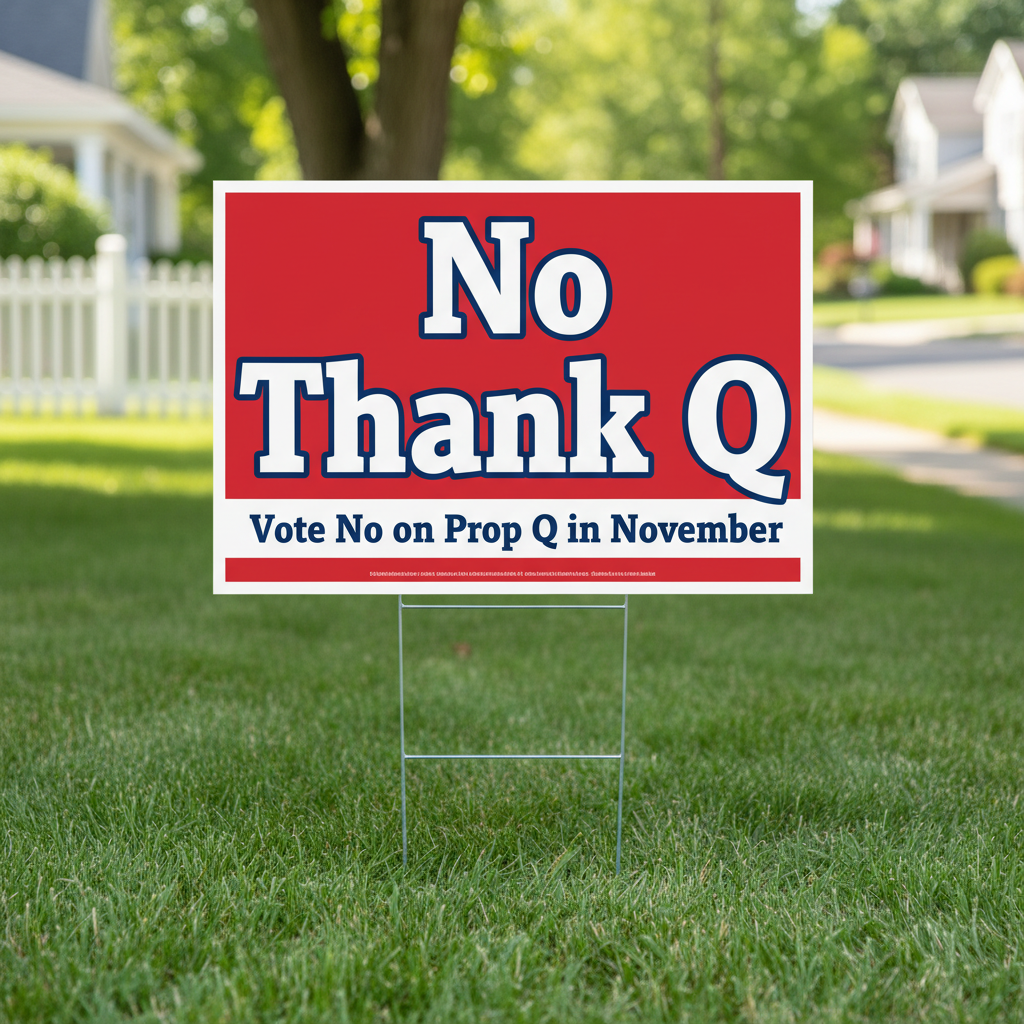
Last November 63% of us told City Hall No Thank Q on a tax hike, and nine months later Council adopted a rate higher than the one we voted down, without an election this time. Prop I writes the independent audit we asked for into the city charter, so Council can’t hold another tax-rate election until an outside firm has been through the books. Vote YES.
A personal project from a concerned Austin resident / Updated September 28, 2026
WHAT WE SAID63.47% voted NO on Prop Q.
WHAT THEY DIDAdopted 57.99¢. Above the rate we rejected.
WHAT PROP I DOESIndependent audit before any tax-rate election. In the charter.
01 / THE NUMBERS
Ten cents in two years, with a “no” vote in the middle.
These come straight from the City’s adopted budgets and tax-rate ordinances, which you can open from the links under the boxes.
CITY TAX RATE · FY 2024-2547.76¢
Per $100 of taxable value, before any of this started.
CITY TAX RATE · FY 2026-27 · ADOPTED AUG 1257.99¢
Higher than the 57.40¢ voters rejected in Prop Q, and adopted at the voter-approval rate so no election was needed.
YOUR INCREASE · TWO YEARS+$512
On a $500,000 home before exemptions, or about $102 per $100k of value. The City’s own median-homestead example is up $113.76 this year alone.
CITY BUDGET · FY 2026-27$6.6B
Up from $3.5B in 2015, while population grew about 10%. The budget grew about 90%.
Rates: FY 2026-27 adopted record and 2025 election record, both linked to the City’s ordinances and taxpayer-impact statements. Dollar figures use the raw rate change so you can do your own math. Your bill depends on your City taxable value and exemptions. Council also took the full voter-approval increase in 2025 (47.76¢ to 52.40¢) even after Prop Q failed, which is why the two-year jump is closer to ten cents than five.
02 / WHAT PROP I DOES
What you’re actually voting on.
Prop I doesn’t set a tax rate; it sets a rule that City Hall has to put an outside firm through the books before it asks voters for a tax-rate increase.
A YES VOTE
Put the audit in the city charter.
Creates an Independent Affordability and Efficiency Initiative: an outside firm reviews City operations every five years, and a review has to be finished within the year before any maintenance-and-operations tax-rate election. The contractor commits to finding more in savings than it charges, and Council can’t repeal any of it without going back to voters.
A NO VOTE
Trust Council’s own ordinance.
Rejects the charter amendment and leaves you with the ordinance Council passed for itself in February 2026: reviews at least three years apart, no requirement to audit before a tax election, and nine council votes to amend or repeal it whenever they like.
Council wrote its own audit ordinance after Prop Q failed; here’s how it stacks up against the one voters petitioned for.
The rule
Council’s ordinance (Feb 2026)
Prop I charter amendment
How often
“Recurring,” with at least three years between cycles. No hard deadline.
Every five years, plus whenever the tax-election trigger applies.
Before a tax election
Nothing. Council can call a tax-rate election without any audit, which is what it did in 2025.
A completed review within the year before the election. No audit, no election.
Savings
“Identify cost savings and performance improvements.” No floor.
Contractor commits to finding savings greater than what it is paid.
Who can undo it
Nine council members, any time.
Only voters, through another charter election.
On the same July 30, 2026 agenda where Council advanced the audit item, it also approved the maximum proposed tax rate for this year, and on August 12 it adopted that rate. The audit is for next time; the increase is for now. Council action record ↗
03 / WHY YES
Everybody says they like accountability. Here’s who voted for it.
What the opposition says, and what we say back.
WHAT CITY HALL SAYS
“We already have an audit ordinance.”
Mayor Kirk Watson and Council Member Marc Duchen say Prop I duplicates Council’s February ordinance and that requiring savings above the consultant’s fee could distort what the consultant recommends. What they’d prefer is the version they control, with no tax-election trigger and a nine-vote repeal switch, and that ordinance only exists because the petition forced the issue.
This site asked for an independent efficiency audit the morning after Prop Q lost. Council answered with a soft ordinance and then adopted a higher rate than the one voters rejected, so if City Hall wants to go back to the ballot for more money, an outside review first is the bare minimum. A contractor that has to find more in savings than it costs isn’t a distortion; that’s the job description. Prop I is the follow-through on the No Thank Q vote.
Not by itself, and we won’t pretend otherwise. Prop I doesn’t set a rate; it makes the next tax-rate election harder to call until an outside audit is on the table. Lower bills come from Council spending less, and this is how you make them look at where the money goes. Read the ballot notice.
Isn’t the City already doing an outside review?
Council passed an ordinance in February 2026, after the petition was already circulating. It has no requirement to audit before a tax election and nine council votes can repeal it. If Prop I fails that ordinance stays; if Prop I passes, the requirement goes into the charter where Council can’t touch it without asking you. See the comparison.
Won’t two audit requirements waste money?
Austin Current reported the City could end up running two processes, which Council can fix in an afternoon by lining its ordinance up with the charter. A city with a $6.6 billion budget complaining about the cost of one outside review isn’t a serious objection. Read the reporting.
Wait, how did the rate go up without a vote?
State law lets the City adopt up to the “voter-approval rate” each year without an election, and that rate gets recalculated annually. In 2026 it came out at 57.99¢, above the 57.40¢ voters rejected in 2025, and Council took all of it, 8 to 2. Legal, yes. Also a pretty clear answer to what voters said last November. See the FY 2026-27 record.
How does this connect to Prop Q?
Prop Q asked for five cents above the cap, and 109,375 Austinites said no against 62,952 who said yes. This site said the next step was an independent efficiency audit; Prop I is that step, with the added rule that it happens before City Hall comes back for more. Read the certified 2025 record.
05 / THE ARCHIVE
Remember “No Thank Q”? We kept the receipts.
The signs, the charts, the myths-vs-facts page, the letters from your neighbors: all of it stays up, along with the certified result and what Council did after.
Check your registration, sample ballot, and polling locations with your county election office. Prop I is a City of Austin measure, and charter propositions come after the candidate races, so read to the end of the ballot.